The Instrument of Return: The Omega Speedmaster X-33 “Ana-Digi” Ref. 3291.50

History has a way of repeating itself—but never in quite the same form.
When astronauts of NASA first slipped the Omega Speedmaster Professional Moonwatch over their wrists in the 1960s, they carried with them a machine that was, even then, already an anachronism: mechanical, analog, resolutely independent of the electronic age it helped inaugurate. It survived vacuum, shock, and flame, and in doing so became myth during the Apollo 11 Moon Landing.
But mythology is a poor substitute for mission architecture.
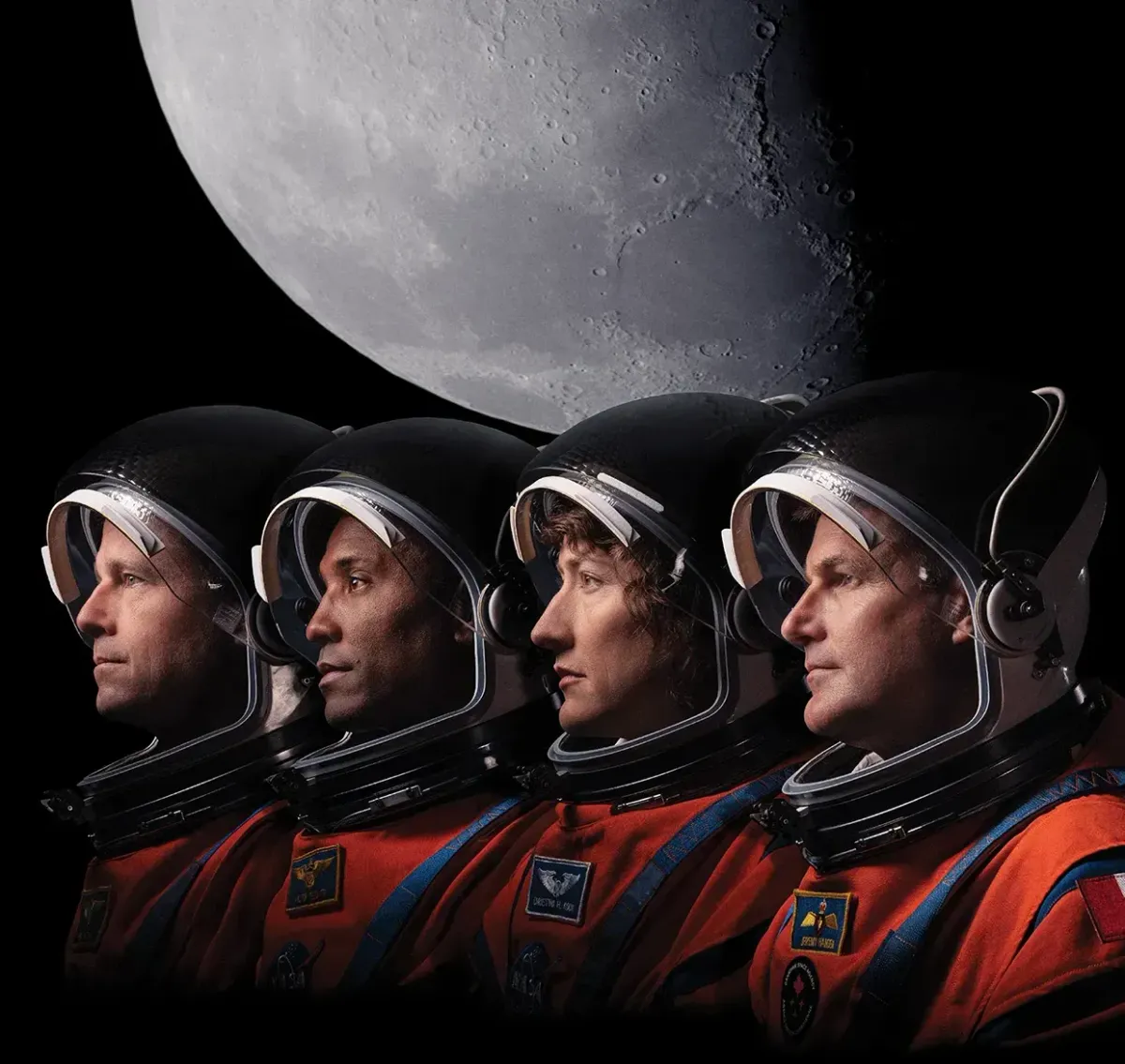
Today’s return to deep space—embodied in Artemis II—demands not only resilience, but integration. Not only durability, but information. The modern astronaut does not simply measure time; he or she inhabits multiple temporalities simultaneously: spacecraft time, Earth time, mission elapsed time, contingency time. Time is no longer singular. It is layered.
And it is precisely here, in this quiet revolution of temporal complexity, that the Omega Speedmaster X-33 Ref. 3291.50 finds its purpose.





Source: NASA
Beyond Romance: The Necessity of Precision
The X-33 does not announce itself with nostalgia. It does not trade on the emotional currency of Apollo. Its titanium case, matte and utilitarian, absorbs light rather than reflecting it. Its dial is not a dial in the traditional sense, but a hybrid interface—hands sweeping over liquid crystal, analog intersecting with digital in a controlled, almost clinical harmony.
Inside beats not a mechanical caliber, but the Omega 1666: a thermo-compensated quartz movement engineered for stability across temperature extremes that would render traditional lubricants erratic, if not useless.
To the purist, this may seem like heresy.
To the astronaut, it is non-negotiable.
Mechanical watches, for all their poetry, are susceptible to the very variables that define spaceflight: temperature gradients, microgravity, cumulative deviation. Quartz, by contrast, offers something far less romantic and far more valuable—consistency. In an environment where milliseconds can compound into navigational error, the X-33’s precision is not a feature. It is a requirement.
The Architecture of Time in Orbit
The genius of the X-33 lies not in any single complication, but in its orchestration of many.
A traditional chronograph measures duration. The X-33 constructs a temporal ecosystem.
Mission Elapsed Time (MET) runs alongside Coordinated Universal Time (UTC). Alarms punctuate the silence of the cabin, marking procedural checkpoints. Countdown timers anticipate burns and maneuvers with a discipline that mechanical pushers alone could never sustain. The backlit display—an almost trivial feature on Earth—becomes indispensable in the dim, instrument-lit interiors of a spacecraft.
This is not redundancy for its own sake. It is cognitive relief.
In high-stress environments, where human attention is a finite resource, the ability to externalize timekeeping—to delegate it to a device that does not tire, forget, or drift—is transformative. The X-33 does not merely tell time; it manages it.
Material as Philosophy
Titanium is often described in watchmaking as a luxury of lightness. In the X-33, it is something else entirely: a philosophy of restraint.
At 42 millimeters, the case is not small, but it wears with a near absence of mass. In microgravity, weight is irrelevant, but inertia is not. Every object, every tool, must justify its presence—not through opulence, but through efficiency. Titanium answers that call with quiet authority: strong, corrosion-resistant, indifferent to the hostile environment it inhabits.
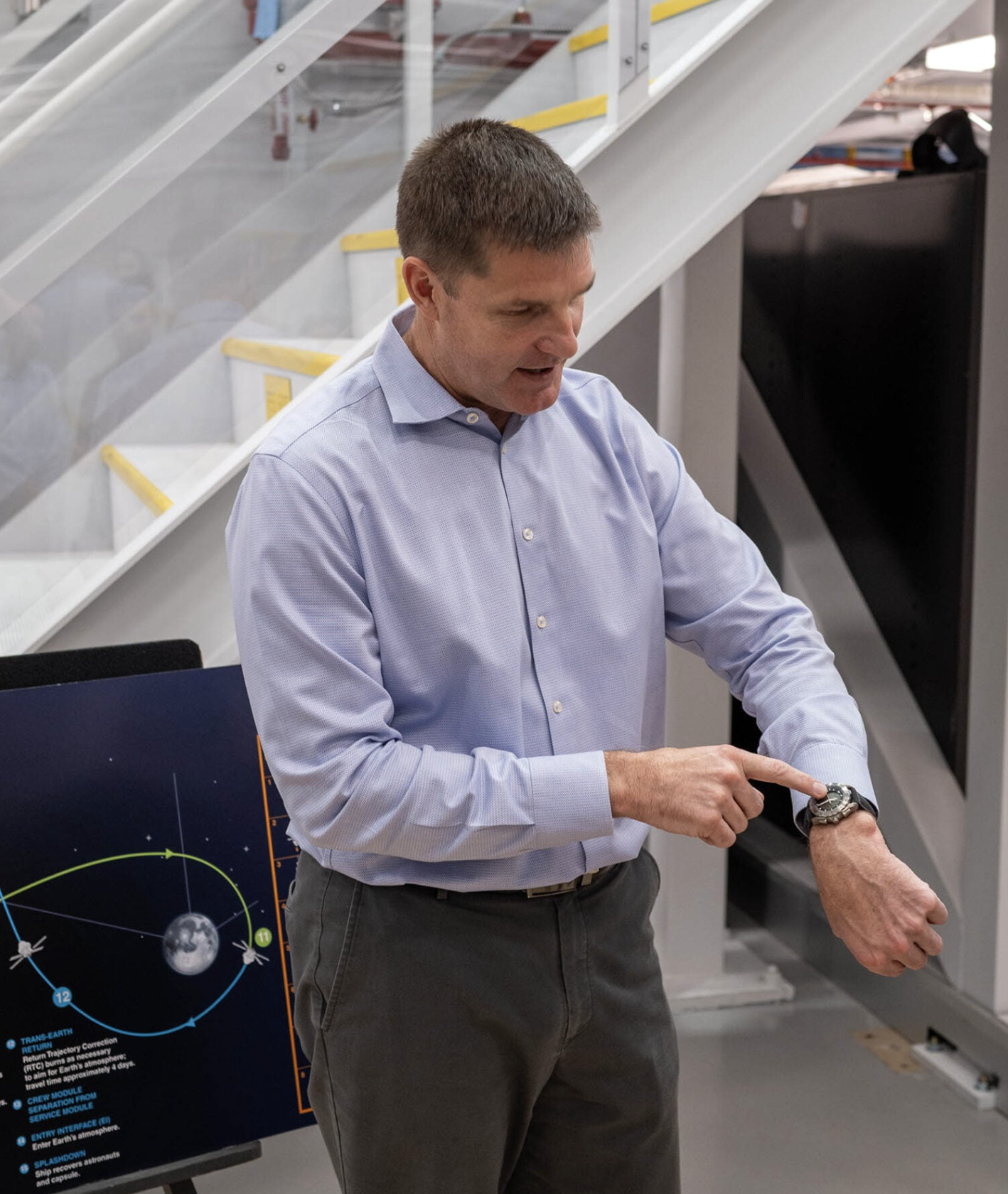
Even the crown—redesigned in this second-generation reference—reveals the watch’s priorities. Enlarged, more tactile, more deliberate, it is meant to be operated not in comfort, but in constraint: gloved hands, divided attention, urgency.
There is no ornament here. Only intent.

Source: NASA
Why This Watch, Now
It is tempting to ask why astronauts—standing on the threshold of a new lunar era—would not return exclusively to the Moonwatch of their predecessors. The answer is both simple and profound.
Because the mission has changed.
The Artemis II crew will not merely replicate Apollo; they will extend it. Their spacecraft is more complex, their data streams denser, their operational demands more intricate. They require tools that reflect that reality.
The X-33, developed with direct input from astronauts, is not an homage. It is a response.
It acknowledges that while history provides inspiration, it cannot dictate solutions. The problems of modern spaceflight are not solved by reverence, but by adaptation.
The Silent Professional
There is a certain irony in the X-33’s obscurity. It lacks the cinematic aura of its mechanical predecessor. It is rarely the centerpiece of collector conversation. It does not command attention across a room.
And yet, it may be the more honest expression of what a space watch must be.
If the Moonwatch was the heroic companion of humanity’s first steps beyond Earth, the X-33 is the quiet professional ensuring those steps can be taken again—this time with greater precision, greater awareness, and greater margin for error.
It is not a symbol.
It is an instrument.
Time, Reconsidered
In the end, the story of the Omega Speedmaster X-33 Ref. 3291.50 is not about replacing the past, but reframing it.
The mechanical chronograph once proved that a watch could survive space.
The X-33 asks a different question:
Can a watch help us operate within it?
As humanity prepares to circle the Moon once more, that distinction becomes everything.