The Return of the Reverse Panda: Omega's Bold New Moonwatch

There's something deeply satisfying about a watch dial that gets the contrast exactly right. Not just readable, but commanding—the kind of visual punch that makes you do a double-take across a crowded room. Omega just delivered that in spades with their latest Speedmaster Moonwatch Professional, and they did it by flipping the script on one of watchmaking's most beloved color schemes.
When Black Meets White
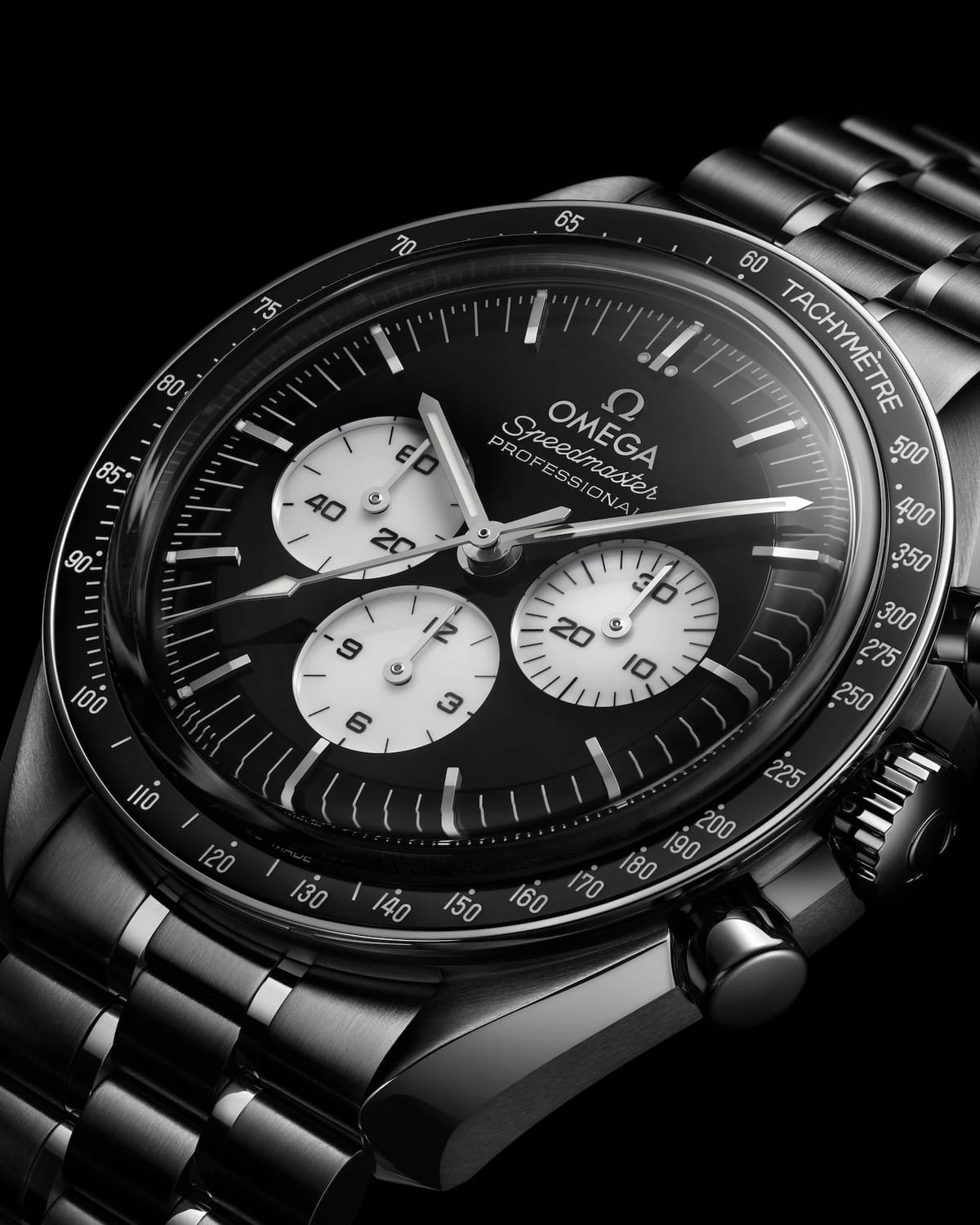
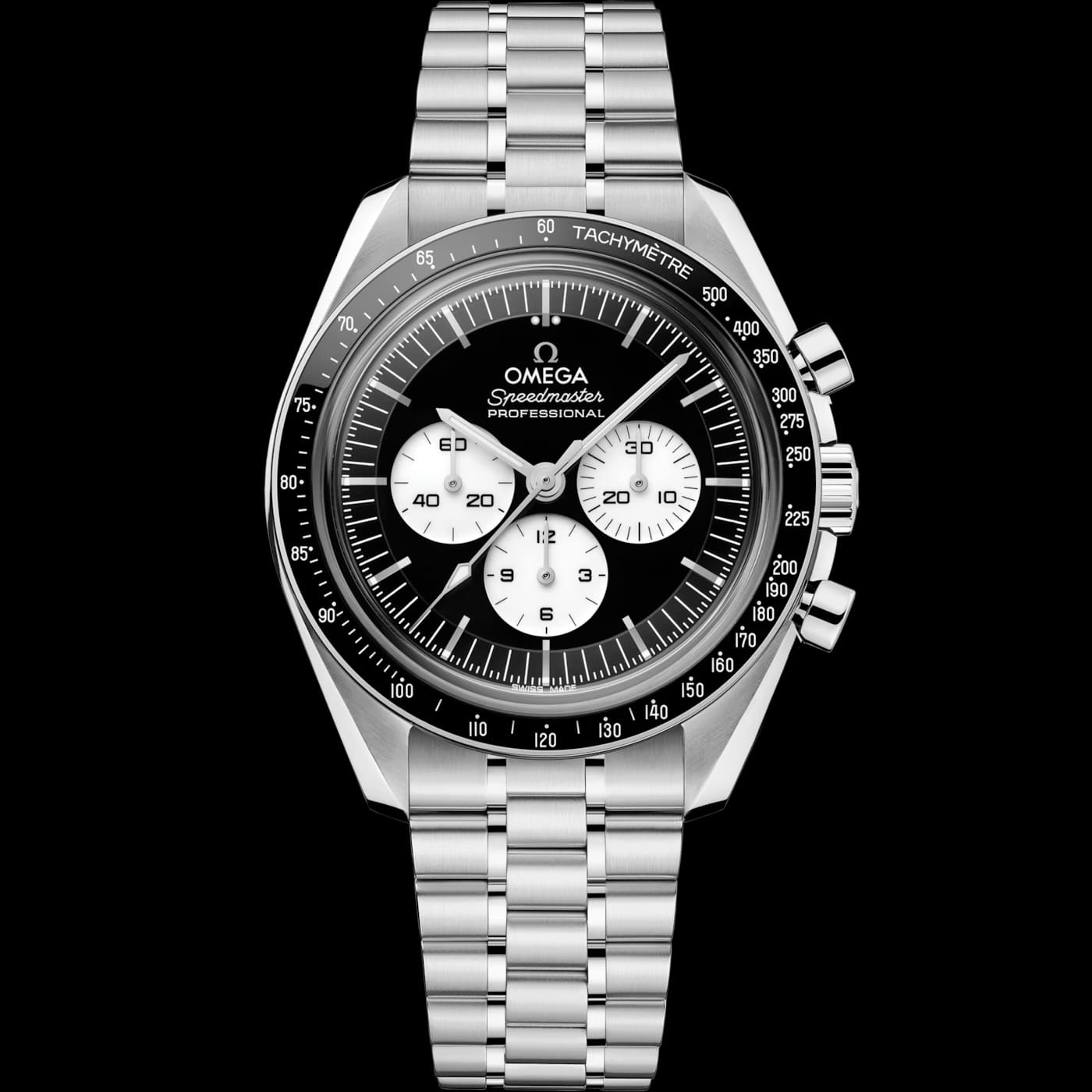
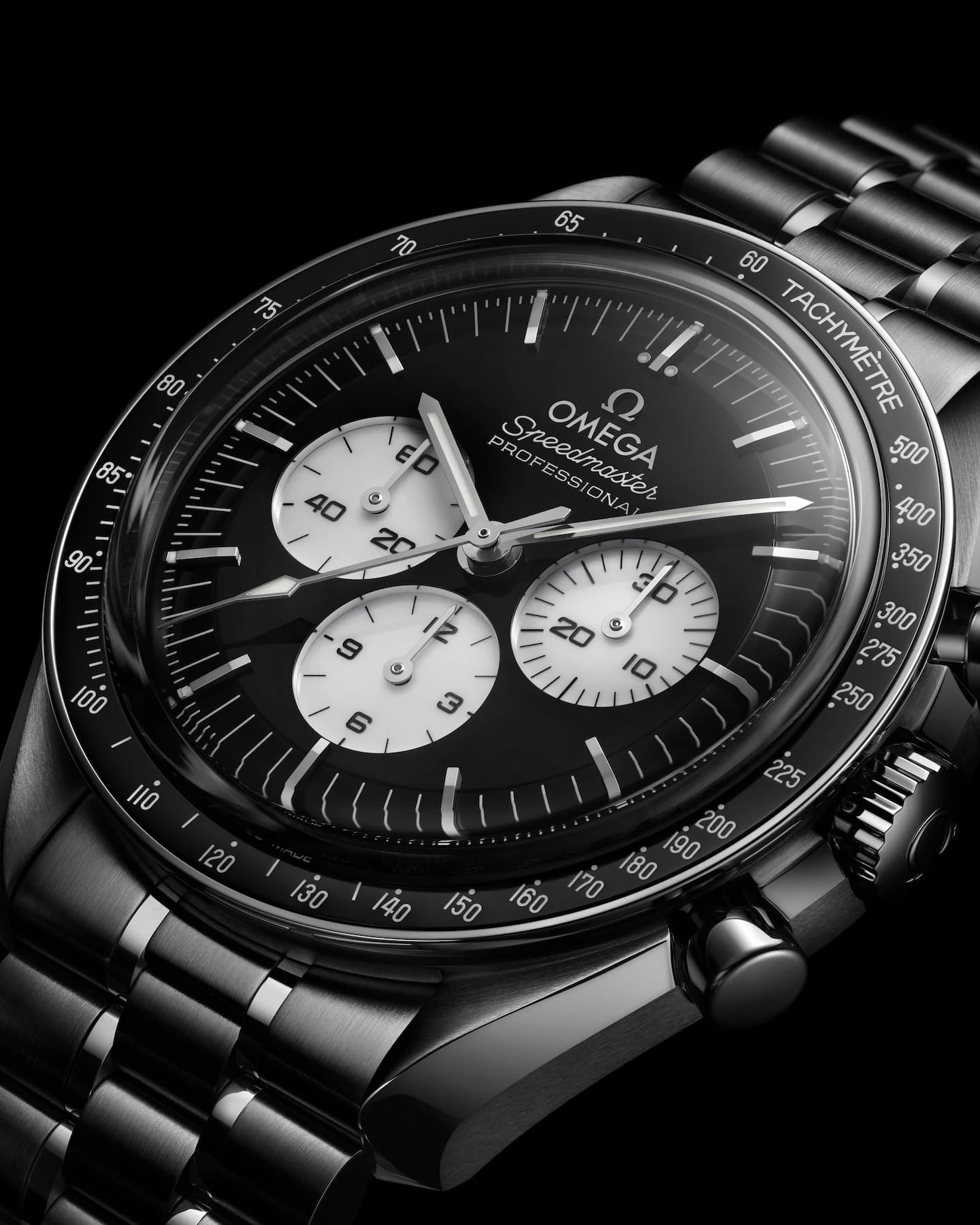
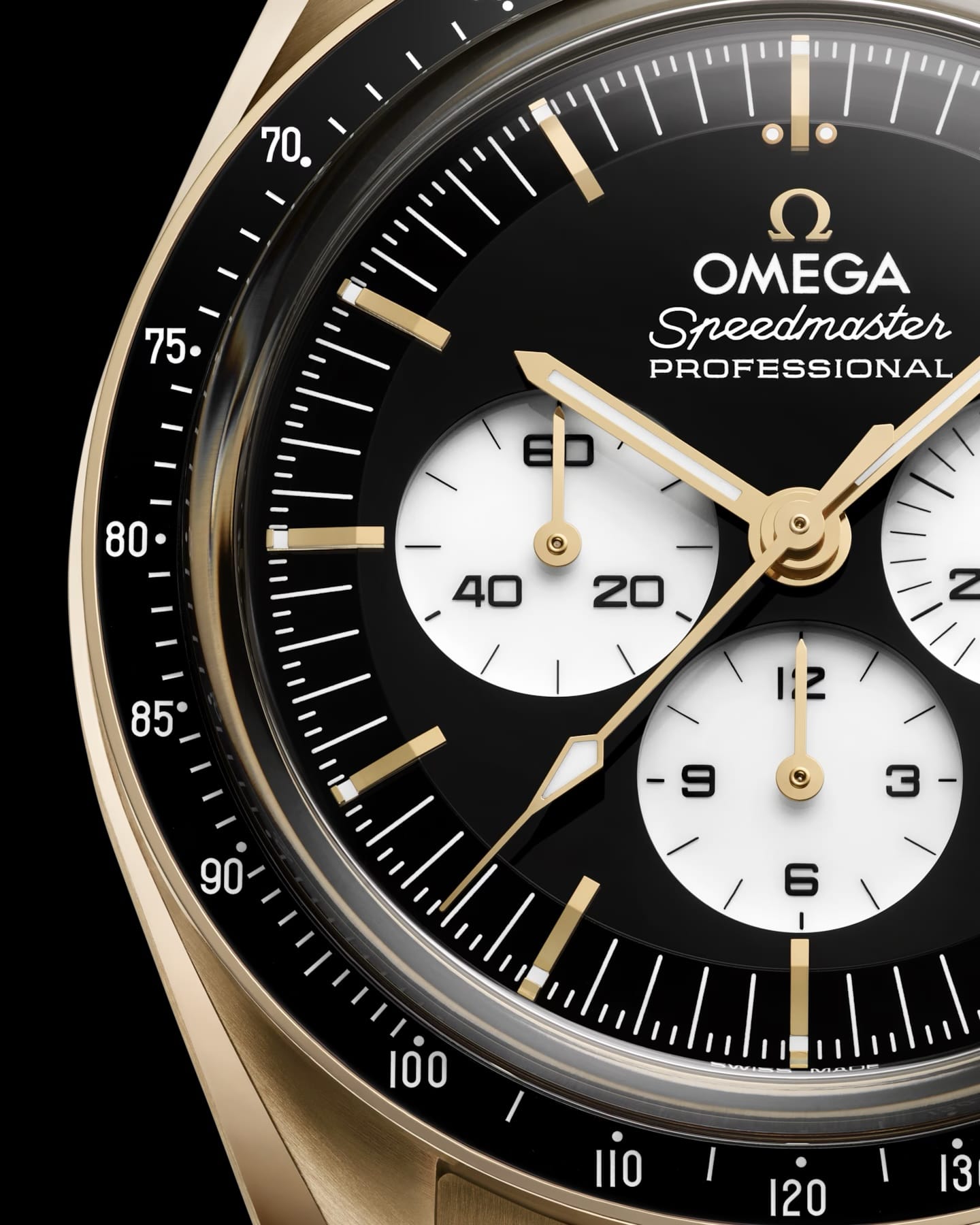
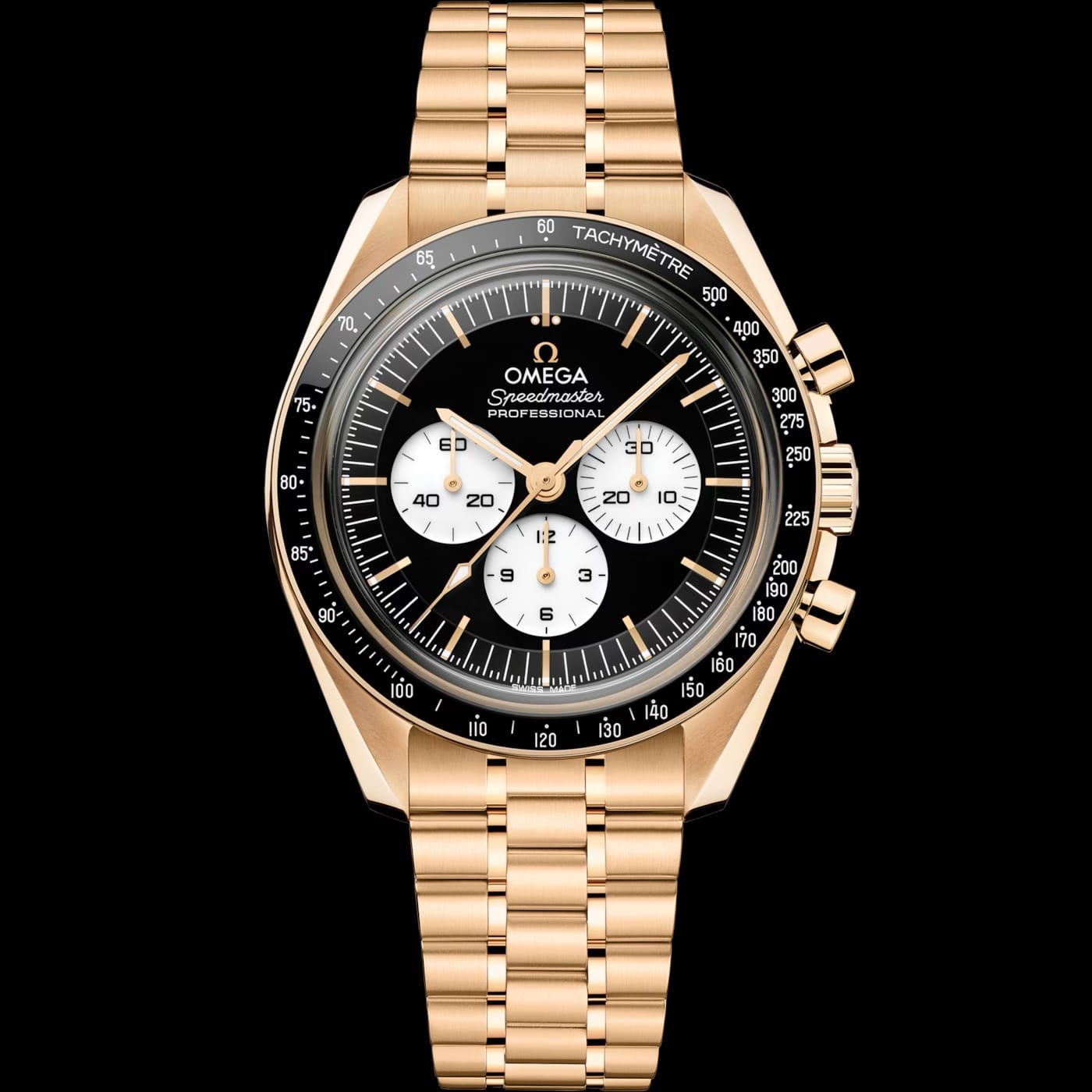
Picture this: a deep black dial, glossy as a grand piano, punctuated by three crisp white sub-dials. It's called a "reverse panda" in watch circles—the photographic negative of the classic panda dial (white background, black sub-dials) that's graced everyone from vintage Rolexs to modern racing chronographs. While panda dials evoke vintage motorsport and sunny California days, the reverse panda brings something different to the table: drama with restraint, presence without flash.
For Omega's Speedmaster—the watch that went to the moon, survived the vacuum of space, and became the only timepiece certified for NASA's manned missions—this marks just the second time this dial configuration has appeared on the flagship Moonwatch Professional. The first was a 2017 limited edition called "Speedy Tuesday" that quickly became collector catnip and now trades for multiples of its original price. Omega clearly got the message.
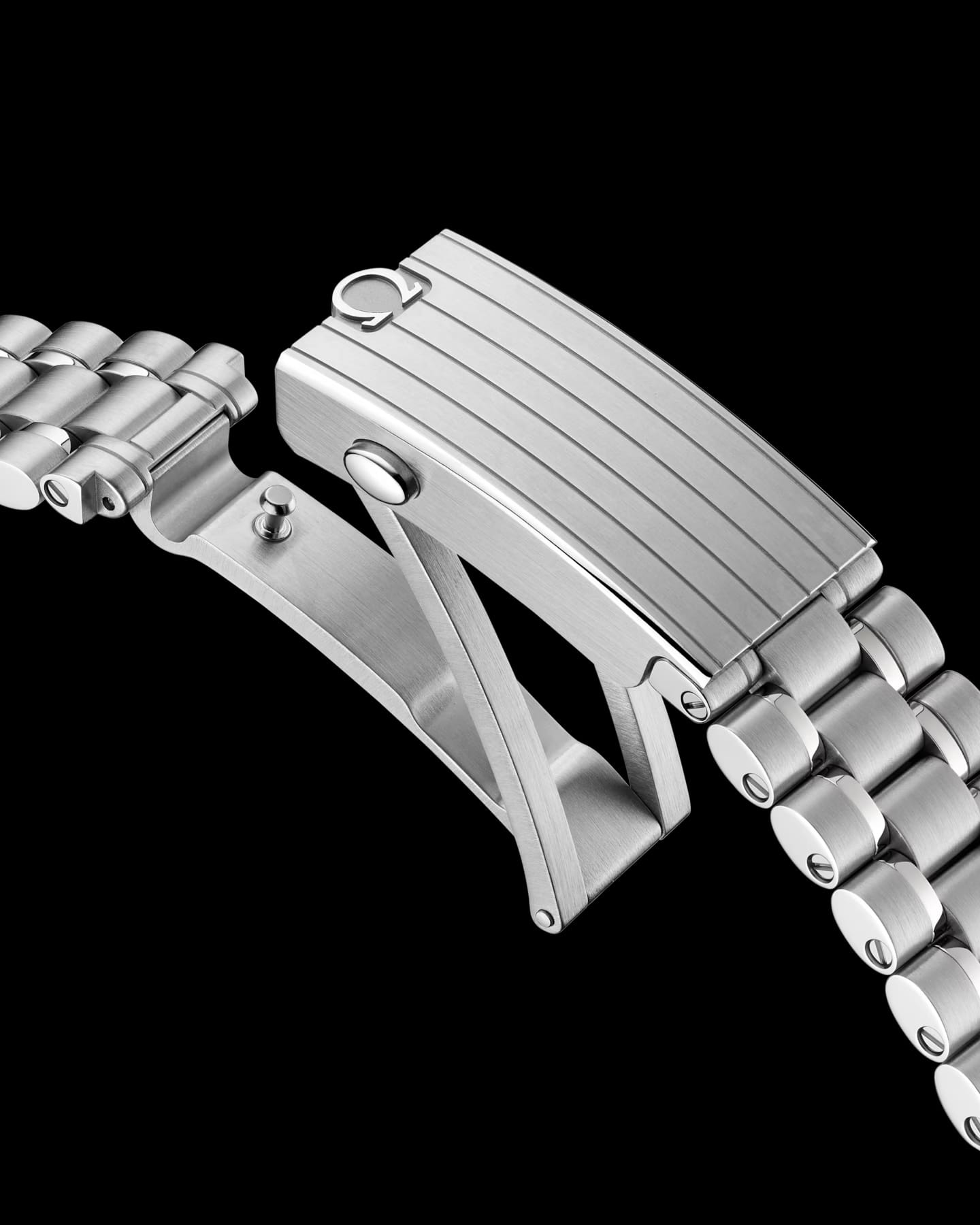
Source: Omega
More Than Just a Pretty Face
What makes these new models particularly interesting isn't just that they look fantastic (though they absolutely do). It's that Omega has loaded them with thoughtful upgrades that transform the wearing experience while respecting the Speedmaster's sacrosanct heritage.
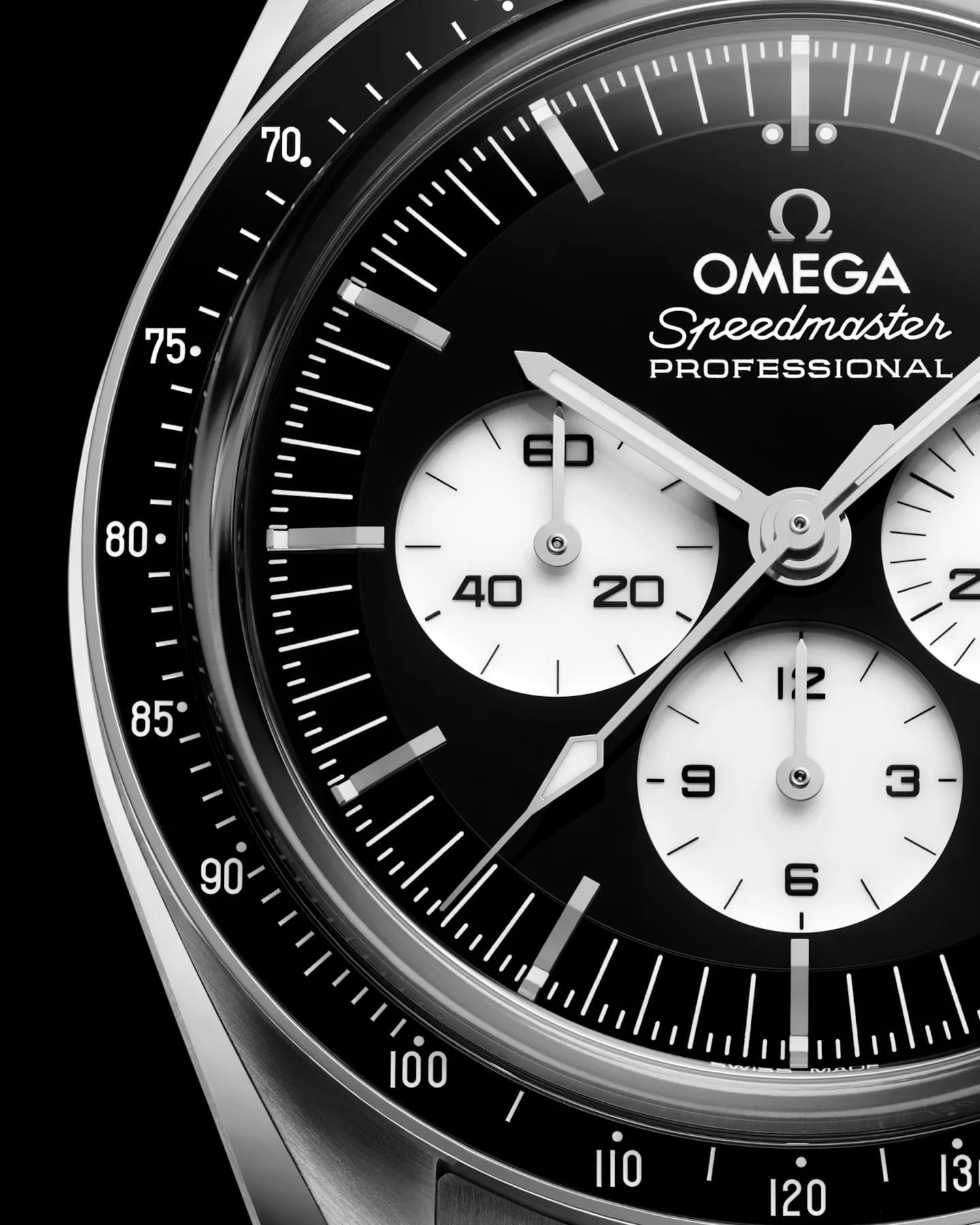
Take the bezel. Traditional Moonwatches wear an aluminum insert—perfectly functional, historically accurate, and prone to the kind of graceful aging that vintage watch enthusiasts swoon over. These new reverse panda models swap that for black ceramic with a white enamel tachymeter scale. For the uninitiated, that means a bezel that's practically scratch-proof and will look pristine decades from now, while purists will appreciate that Omega preserved nerdy details like the "dot over ninety" marking—a quirk of the original 1960s design.
The dial itself is a study in manufacturing sophistication. That mirror-finish black lacquer sits on a stepped construction that creates subtle depth and shadow play. The white sub-dials aren't just painted on—they're fully lacquered elements that catch light differently than the base, creating dimension that photographs simply can't capture. Under bright light, it's striking. In low light, it transforms into something almost architectural.
The Heart of the Matter
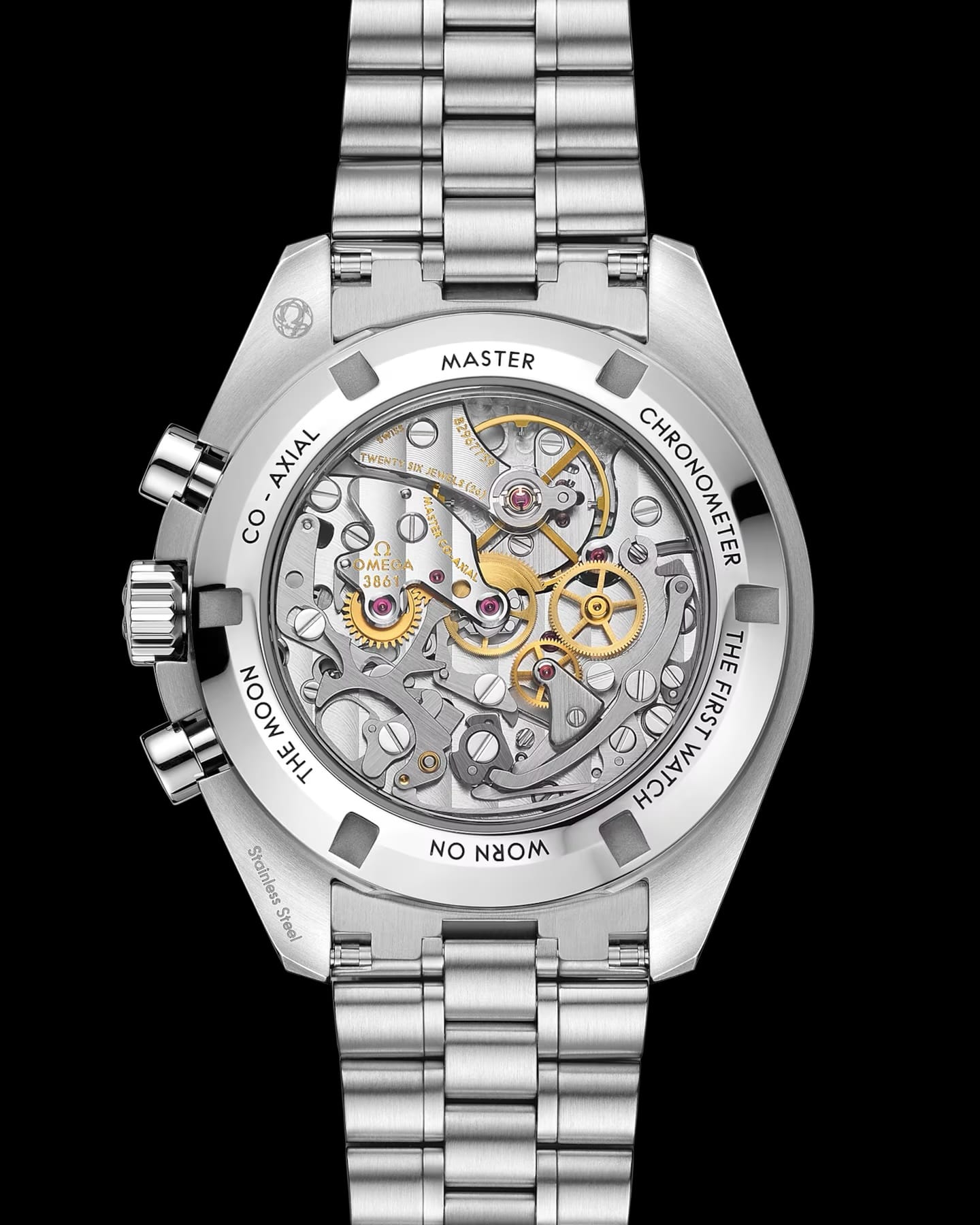
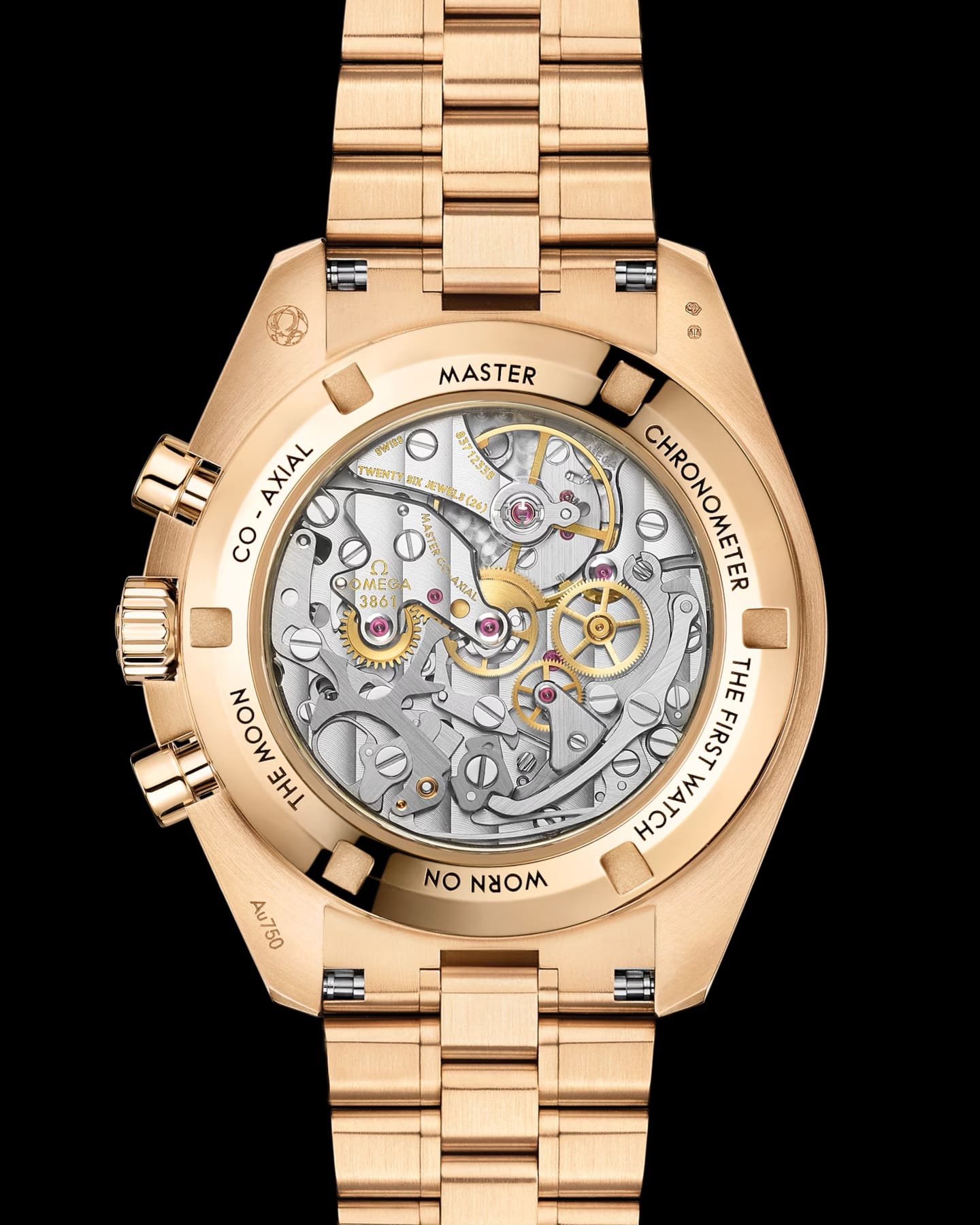
Inside both versions—there's a stainless steel model and an 18K "Moonshine Gold" variant (Omega's proprietary alloy with extra silver for a warmer, more stable color)—beats the Calibre 3861. If you're not deep into watch mechanics, here's what matters: this is a hand-wound chronograph movement that's both a direct descendant of what Neil Armstrong wore on the moon and a thoroughly modern caliber.
It features a Co-Axial escapement (which reduces friction and improves long-term accuracy) and a silicon hairspring (unaffected by magnetic fields and temperature changes). It's also Master Chronometer certified, meaning it can withstand magnetic fields up to 15,000 gauss—the kind you'd encounter near MRI machines or induction cooktops. The original moon landing watches? They'd stop dead in their tracks.
Yet the 3861 retains the cam-lever chronograph architecture of those vintage movements, the satisfying mechanical clicking when you activate the pushers, the visual beauty of hand-finishing on components you'll rarely see. It's a 50-hour power reserve waiting to be wound by your fingertips each morning—a ritual that connects you to the watch in a way automatic movements simply don't.
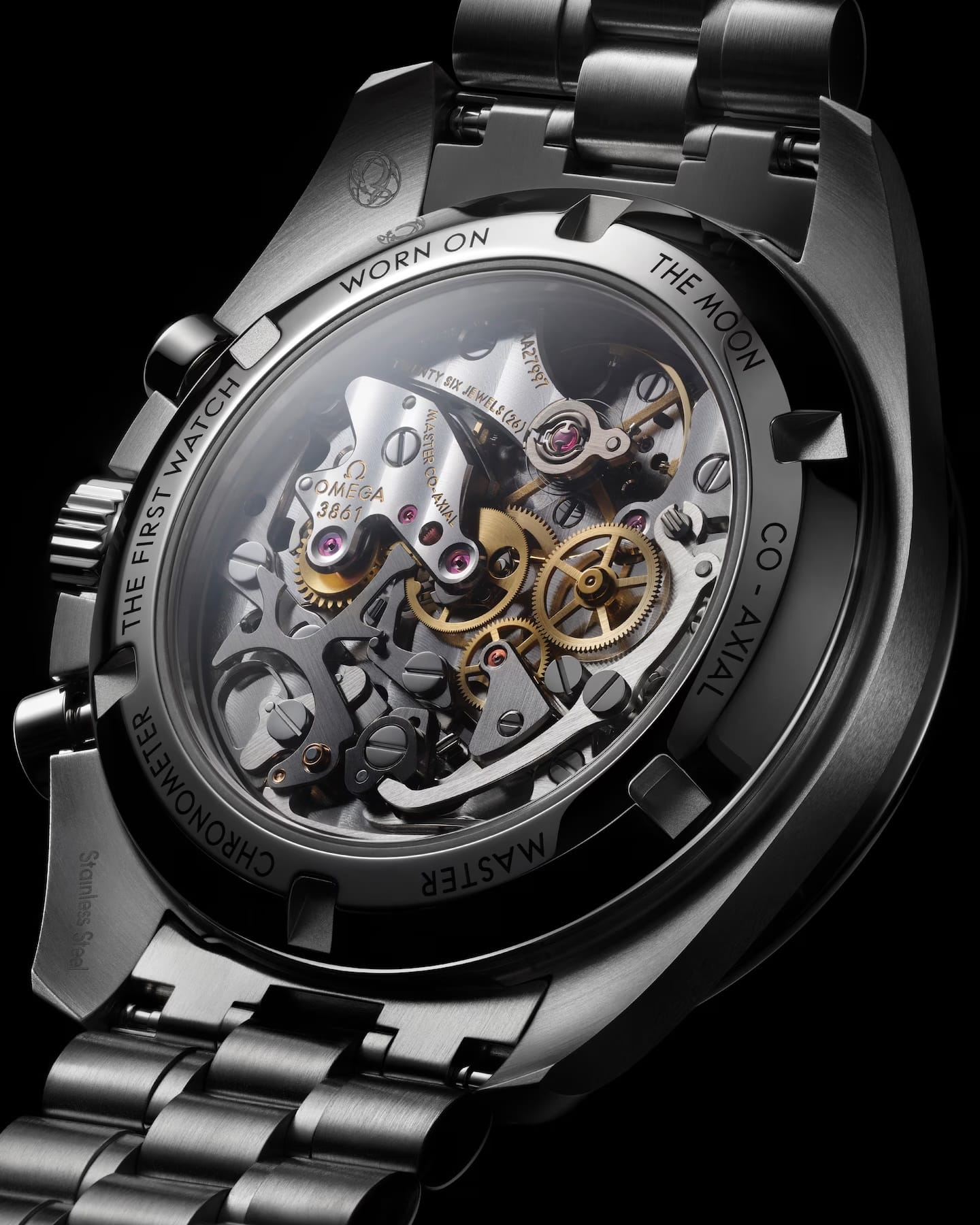
Source: Omega
Context Is Everything
To understand why collectors are excited about these, you need to know that the Speedmaster Professional isn't just another luxury watch. It's been to the moon six times. It's the watch Buzz Aldrin wore during humanity's first steps on another world. It's been on every NASA mission since 1965 where a watch was worn. When the oxygen tank exploded on Apollo 13 and the crew had to time a critical engine burn using a watch because the spacecraft's instruments were offline, guess what they used?
This isn't marketing mythology—it's documented history. And that history has made the Speedmaster one of the most culturally significant watches ever created, sitting alongside icons like the Rolex Submariner and the Audemars Piguet Royal Oak.
So when Omega creates a new Moonwatch variant, they're not just releasing another product. They're adding to a legacy that connects directly to human achievement and exploration. The reverse panda dial offers a way into that story with a look that stands apart from the thousands of standard black-dial Speedmasters in circulation.
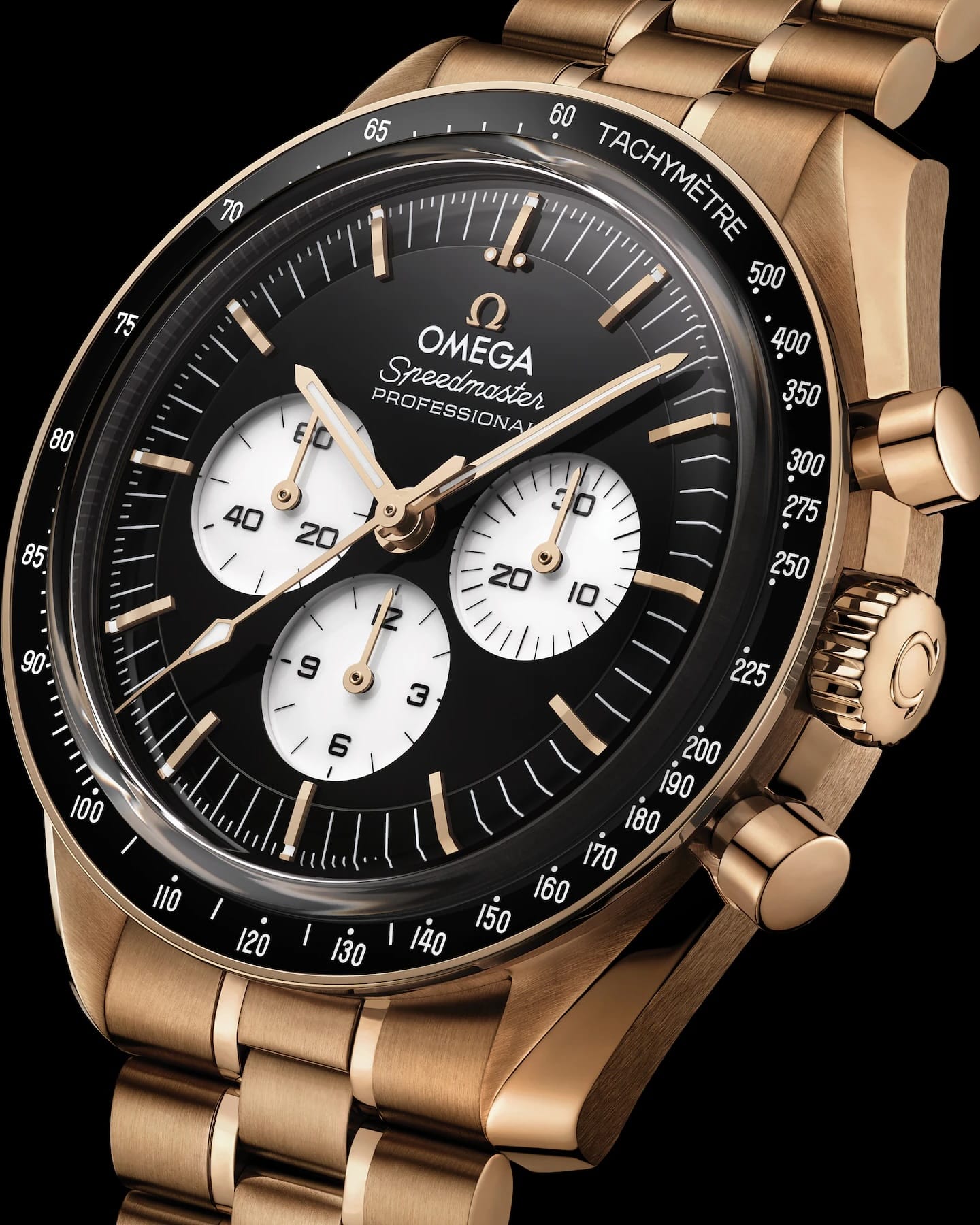
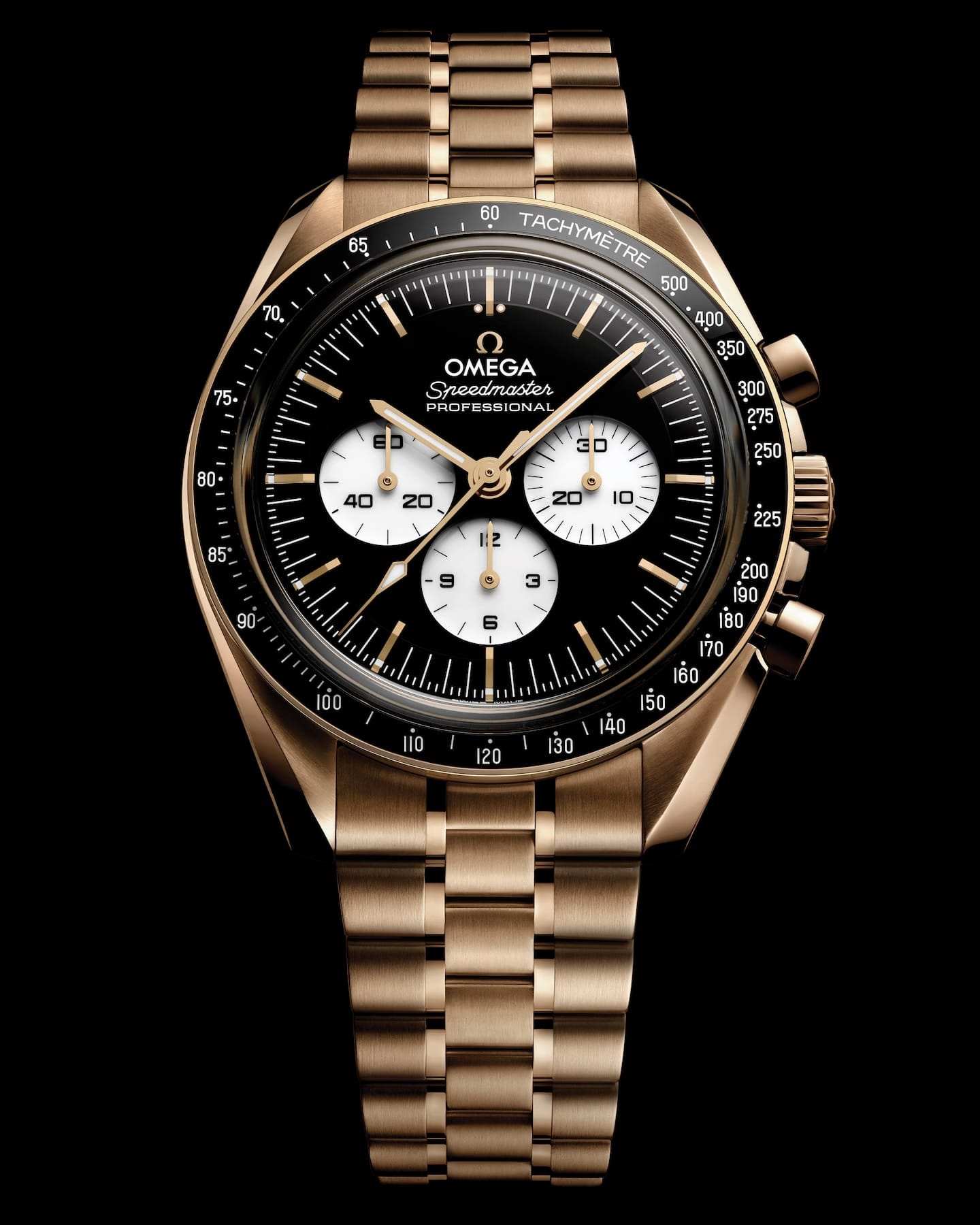
Source: Omega
The Money Question
Here's where things get interesting from a market perspective. The steel version rings in at €10,200 (roughly $10,400), while the Moonshine Gold demands €48,600 (about $49,300). Compare that to the standard Moonwatch Professional on bracelet at around $7,800, and you're looking at a 30% premium for the steel reverse panda.
Is it worth it? That depends entirely on what you value. You're paying for the ceramic bezel upgrade, the unique dial execution, and yes, the exclusivity of owning something distinctive. In the luxury watch world, where a different dial color can add thousands to a price tag, this isn't unreasonable—though it's certainly not cheap.
The gold version competes in a different arena entirely, going head-to-head with precious metal chronographs from the industry's heavyweights. At nearly $50,000, it's a serious investment piece, though one with significant aesthetic and technical merit to justify its place in that rarefied air.
Why Now?
Omega's timing reveals strategic thinking. They've made a tradition of Speedmaster announcements on the first Tuesday of January. They'd already proven with 2024's white-dial Moonwatch that collectors were hungry for fresh takes on the classic design—that model sold exceptionally well and dominated social media feeds. And they'd built anticipation by having actor Colman Domingo wear the gold reverse panda to the 2025 Met Gala, generating months of speculation.
More broadly, this fits into how luxury watch brands are evolving. Rather than constantly chasing the next complicated complication or avant-garde case shape, the smartest brands are mining their archives for proven designs and offering them in configurations that feel both fresh and familiar. It's how Rolex sells Daytonas with different dial colors for wildly different prices. It's how Patek Philippe keeps their Nautilus relevant across generations.
Omega is essentially saying: "We have one of watchmaking's most perfect designs. Instead of messing with it, we're going to offer it in variations that let you express your individual taste while maintaining everything that makes it special."
On the Wrist
The 42mm case size hits a sweet spot—substantial enough to have presence, compact enough to slip under a shirt cuff. The asymmetrical case with its distinctive crown guards and "lyre-shaped" lugs creates a silhouette that's recognizable from across a room. And that reverse panda dial? It delivers visual impact in a way that's sophisticated rather than shouty.
The black base creates an almost stealthy elegance that works brilliantly in professional settings, while the white sub-dials ensure you can actually read the chronograph functions at a glance—crucial for a watch whose entire reason for existence is utility. It's the rare combination of tool watch legibility and dress watch refinement.
The Collector's Calculus
Early reactions from the watch community have been enthusiastic, with many pointing to the 2017 Speedy Tuesday's secondary market performance as a potential indicator. That watch, originally priced around $5,400, now trades for significantly more—scarcity plus desirability equals appreciation.
But here's the twist: Omega made these part of the permanent collection rather than limited editions. That's both good and bad for collectors. Bad if you're purely hunting investment pieces (scarcity drives value). Good if you actually want to buy and wear one without fighting through a waitlist or paying grey-market premiums.
It's a refreshingly honest approach in an industry that sometimes manufactures artificial scarcity. Omega seems to be saying: "We made something beautiful. If you want one, you can buy one. But you'll pay for the privilege of owning something special."
The Verdict
These new Omega Speedmaster Moonwatch "Black and White" models represent thoughtful evolution rather than revolution—and that's exactly what makes them compelling. They take one of the most important watches in horological history and offer it in a format that honors tradition while embracing contemporary manufacturing excellence and aesthetic preferences.
For watch enthusiasts, they're a chance to own a piece of space exploration heritage in a configuration that's both rare and wearable. For those new to serious watches, they're an entry point into a story that connects directly to human achievement, wrapped in a package that looks absolutely killer.
The premium pricing will make some pause, but in the luxury watch market, distinctive dial configurations command distinctive prices. Whether that equation works for you depends on how much you value standing out from the crowd of standard Moonwatch wearers—and how deeply the reverse panda aesthetic speaks to you.
What's certain is this: when Omega decides to create a new Moonwatch variant, they're not just making another watch. They're adding a new chapter to one of the most storied designs in watchmaking history. And sometimes, the most powerful innovations come not from reinventing the wheel, but from seeing a classic through fresh eyes.
The reverse panda Moonwatch proves that even a watch that's been to the moon can still surprise us here on Earth.