Jaeger-LeCoultre's Duometre Heliotourbillon Perpetual in Platinum

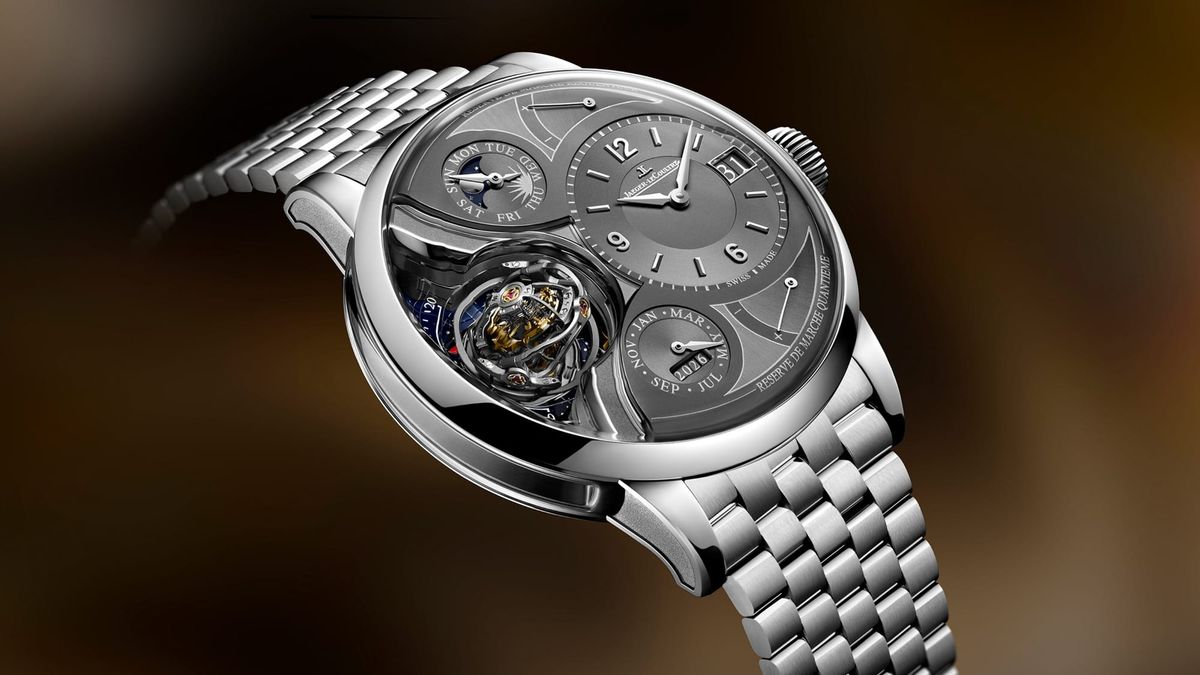
A 20-piece limited edition that distills decades of horological ambition into 44mm of platinum 950 — and asks whether a watch can be both a scientific instrument and a work of art at the same time.
A Watch That Shouldn't Exist
There is a particular kind of watch that exists not to be worn, but to be understood. The Jaeger-LeCoultre Duometre Heliotourbillon Perpetual in platinum 950 is that watch.
Unveiled at Watches & Wonders 2026 and limited to just 20 numbered pieces, this new platinum execution of the Duometre Heliotourbillon Perpetual — first introduced in 18k pink gold at Watches & Wonders 2024 — represents the Vallée de Joux manufacture at its most uncompromising. It is a timepiece that stacks three of watchmaking's most demanding complications — a triple-axis tourbillon, a perpetual calendar with grande date, and the patented Duometre dual-gear-train architecture — into a single 44mm case, and then wraps the whole thing in one of horology's most coveted materials. The result is a watch that feels, at first encounter, almost impossible to have been made. And yet, somehow, it was.
The Architecture of Precision: Understanding the Duometre Concept
To appreciate what Jaeger-LeCoultre has achieved here, it helps to understand the problem the Duometre concept was designed to solve. For most of watchmaking history, adding complications to a movement was a zero-sum game: every additional function — a calendar, a chronograph, a moon phase — drew energy from the same mainspring barrel that powered the escapement. The result was an inevitable compromise between complication and accuracy. The more a watch did, the less reliably it kept time.
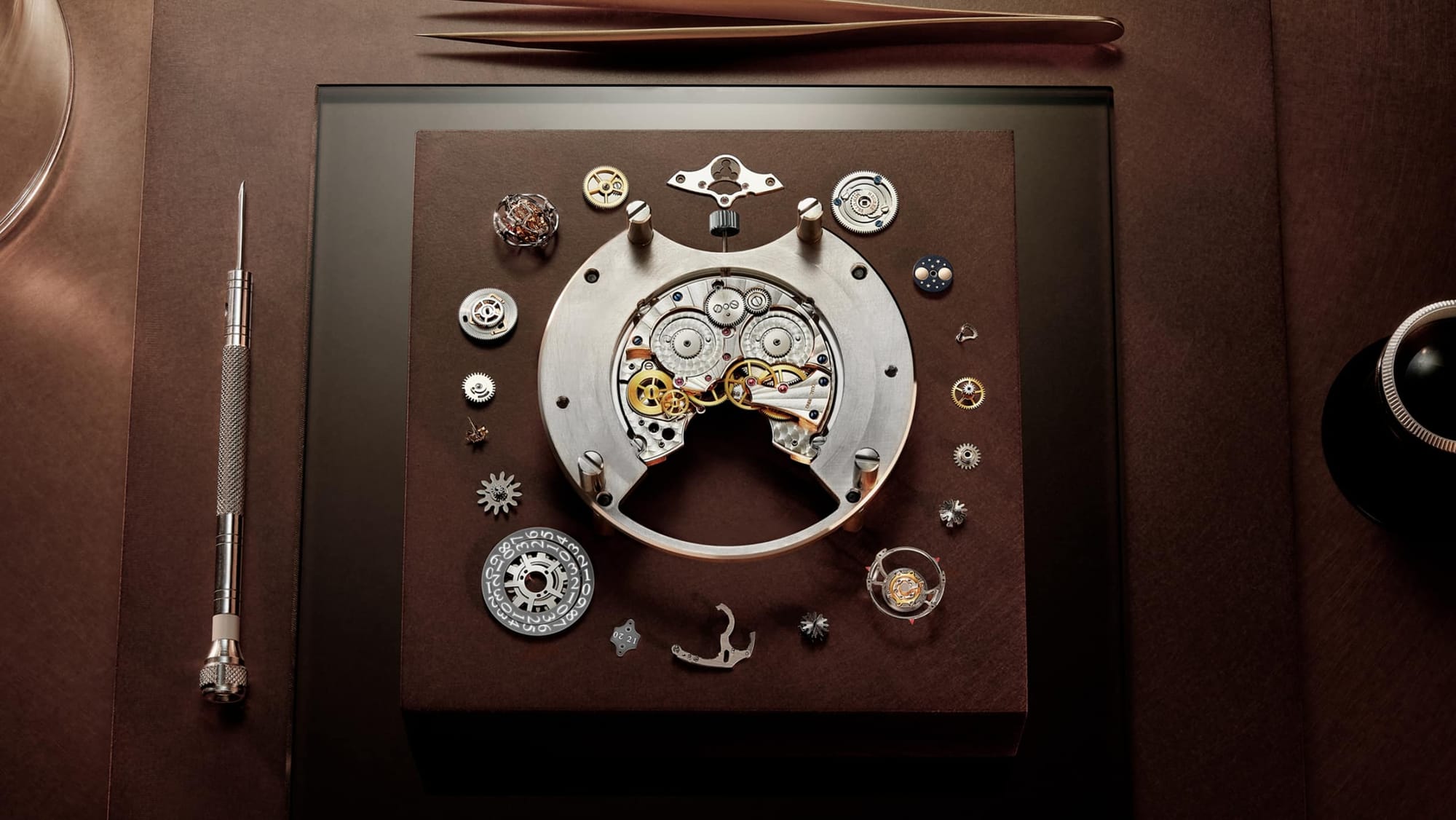
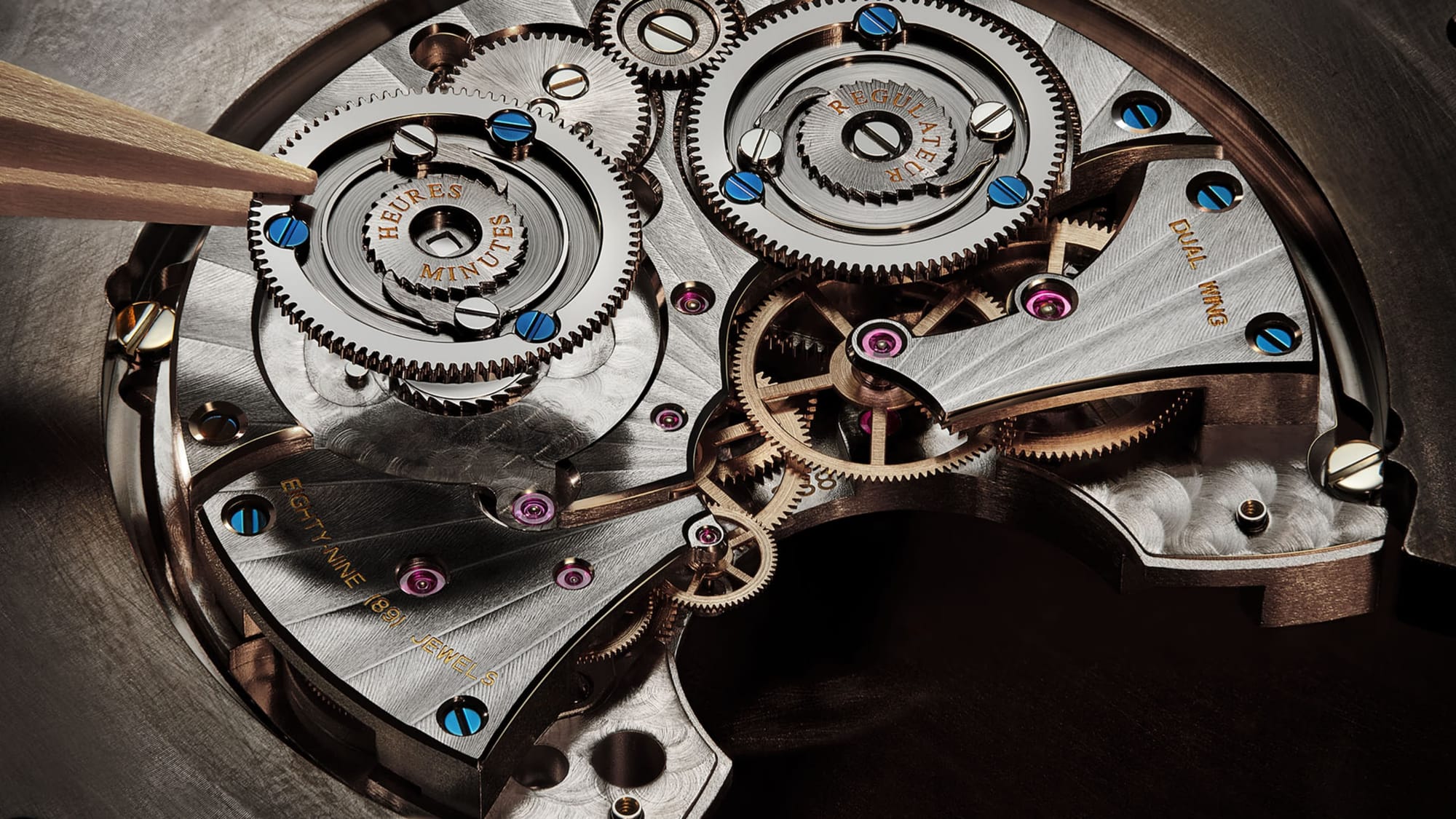
In 2007, Jaeger-LeCoultre patented a solution. The Duometre mechanism employs two independent mainspring barrels and two separate gear trains, both linked to a single regulating organ. One train is dedicated exclusively to timekeeping; the other powers all additional complications. The escapement receives a clean, uninterrupted flow of energy regardless of what the calendar or moon phase mechanism is doing. Each barrel delivers approximately 46 hours of power reserve independently.
It is an elegant solution to a fundamental problem — and it is the foundation upon which the Heliotourbillon Perpetual is built. Without the Duometre architecture, a movement of this complexity would be a chronometric liability. With it, the complications become passengers rather than parasites.
Source: JLC
The Heliotourbillon: Three Axes, 163 Components, Less Than 0.7 Grams
The tourbillon, invented by Abraham-Louis Breguet in 1801, was conceived as a solution to the problem of positional error — the tendency of a pocket watch's balance wheel to lose accuracy when held in a fixed vertical position under the influence of gravity. By mounting the escapement in a rotating cage, Breguet ensured that the balance wheel experienced gravity from all directions equally, averaging out the error over time.
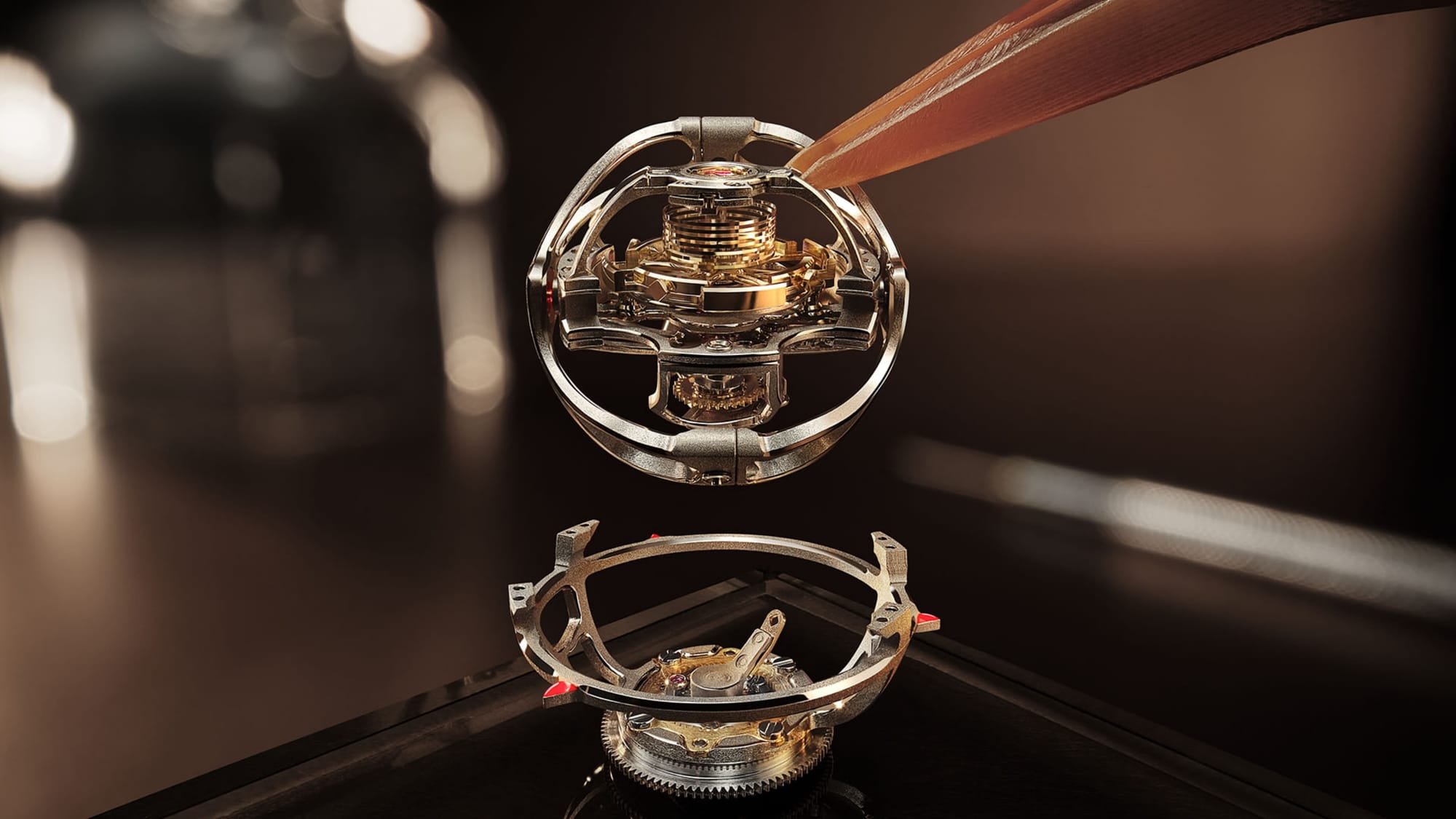
The single-axis tourbillon remained the standard for nearly two centuries. Then, in 2004, Jaeger-LeCoultre introduced the Gyrotourbillon — a dual-axis construction that rotated on two planes simultaneously, offering more comprehensive compensation. The Heliotourbillon, introduced with Calibre 388 in 2024, takes this evolution one step further: three axes, three titanium cages, rotating in a gyroscopic pattern that JLC describes as a "spinning top" effect.
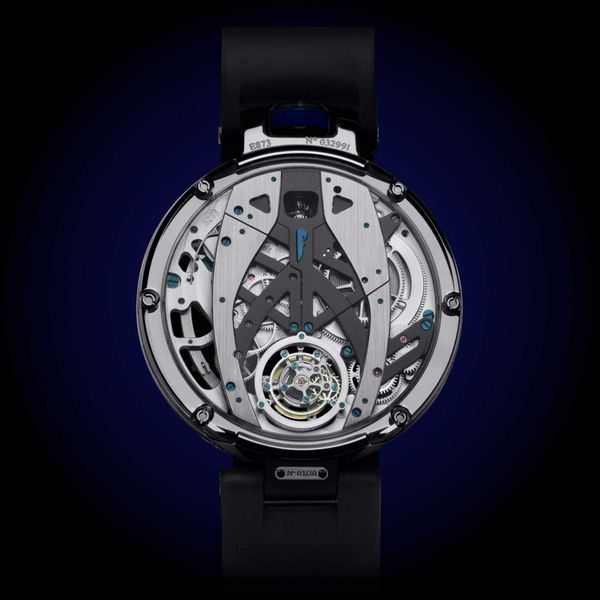
The geometry is precise and deliberate. The first cage is set at a 90-degree angle to the balance wheel. The second cage is perpendicular to the first, and together they are constrained by an axis tilted at 40 degrees, completing a full rotation every 30 seconds. The third cage is perpendicular to the second and rotates once per minute. The entire assembly — 163 components in total — is supported on ceramic ball bearings to minimize friction, and fitted with a cylindrical hairspring for additional positional stability. The whole structure weighs less than 0.7 grams.
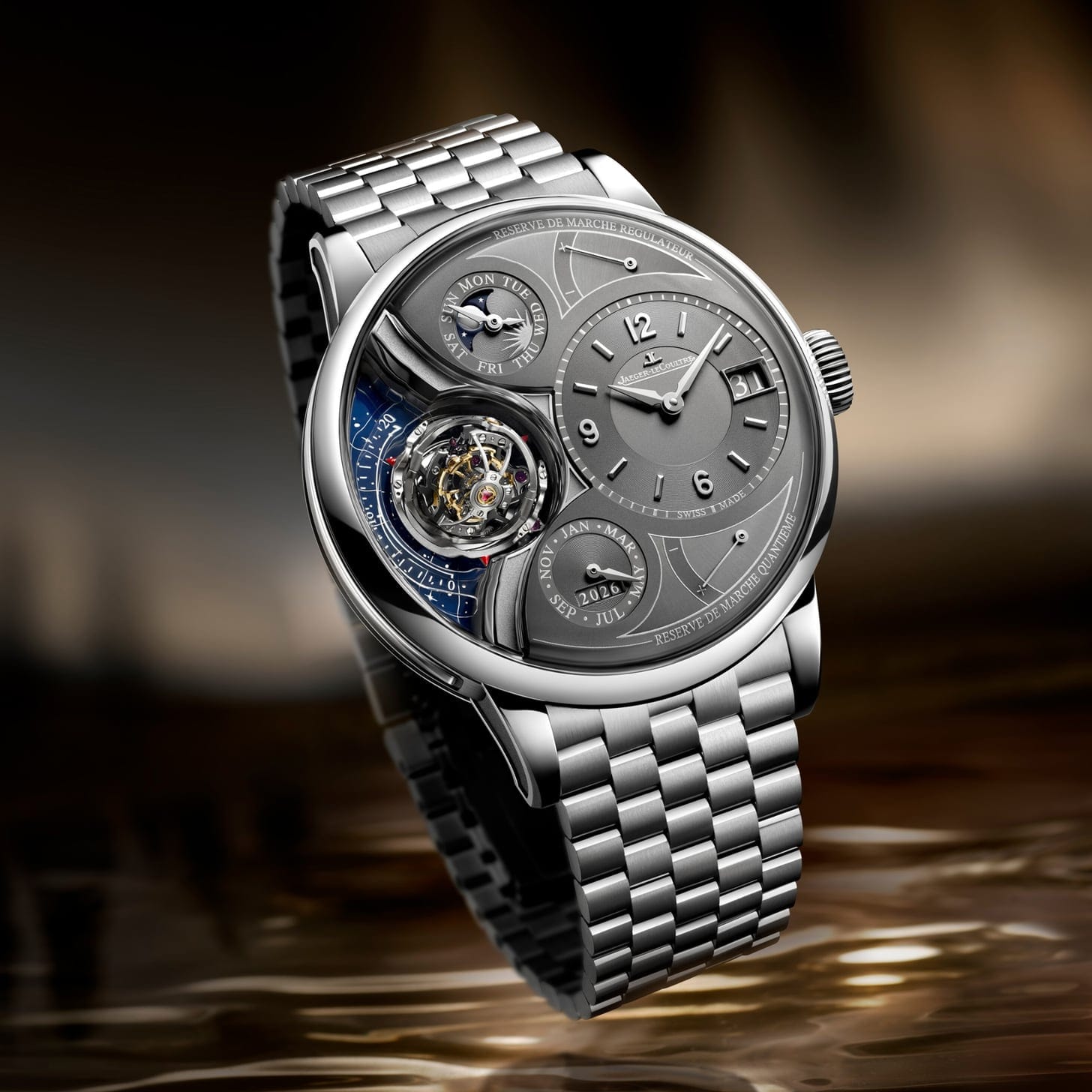
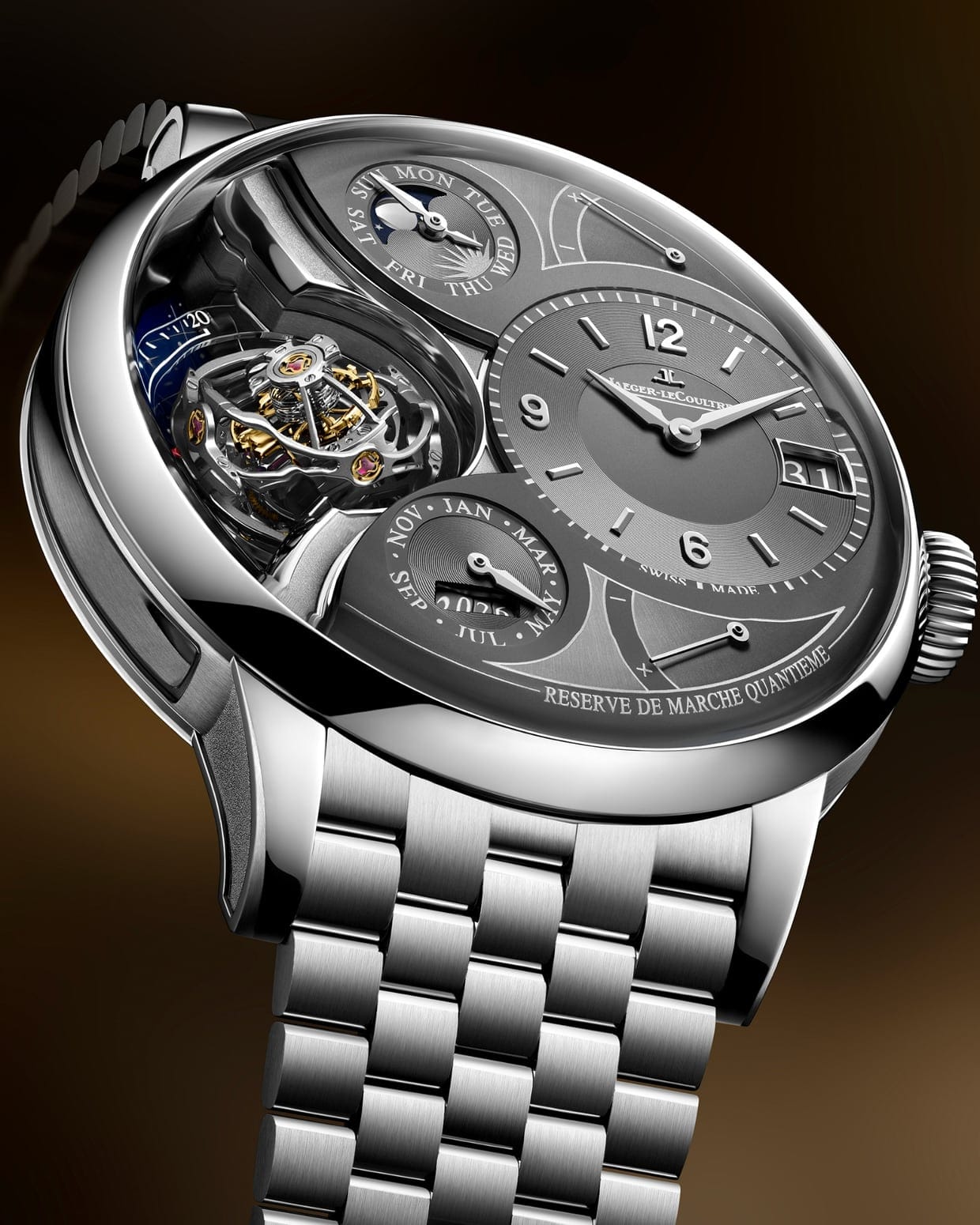
That last figure deserves a moment of reflection. One hundred and sixty-three components. Less than 0.7 grams. The engineering density implied by those two numbers is staggering — and it is visible through the sapphire crystal window cut into the left flank of the case, where the cages gyrate in their deep blue lacquer "starry sky" setting, red triangles on the third cage marking 20-second intervals against a curved sapphire arc.
Source: JLC
The Perpetual Calendar: A Machine That Knows the Calendar Until 2100
The Heliotourbillon is the spectacle. The perpetual calendar is the substance. Calibre 388's calendar mechanism tracks the date, day, month, moon phase, and year — including the irregular distribution of 28-, 29-, 30-, and 31-day months — without requiring manual correction until the year 2100, when the Gregorian calendar's century-year exception will require a single adjustment.
The grande date display, positioned at 3 o'clock, uses two discs appearing through a single rectangular aperture — a classical complication that prioritizes legibility without sacrificing elegance. The moon phase indication is accurate to one day in 122 years. And in a detail that speaks to JLC's engineering thoroughness, the calendar mechanism is designed so that it will only advance when the time is set forward — meaning the calendar cannot be damaged by setting the time backward, a failure mode that has plagued perpetual calendars for generations.
The leap year indication carries a characteristically JLC touch: the last digit of every leap year is displayed in red — a Jaeger-LeCoultre patent that transforms a technical necessity into a quiet visual flourish.
The Platinum Case: Cold, Dense, and Exactly Right
The original Duometre Heliotourbillon Perpetual debuted in 18k pink gold — warm, traditional, and entirely appropriate for a dress watch of this caliber. The platinum 950 version announced in 2026 is a different proposition entirely. Platinum is denser than gold, cooler to the touch, and carries a particular gravity — both literal and figurative — that suits a watch of this technical ambition.
The 44mm savonette-inspired case, drawn from JLC's 19th-century pocket watch heritage, comprises 40 separate components in the platinum version (up from 34 in the pink gold original). The screwed lugs — attached separately rather than integrated — allow JLC's finishers to apply three distinct surface treatments across the case architecture: high polish, brushing, and microblasting. The convex sapphire crystal and deeply notched winding crown reinforce the watch's tactile presence.
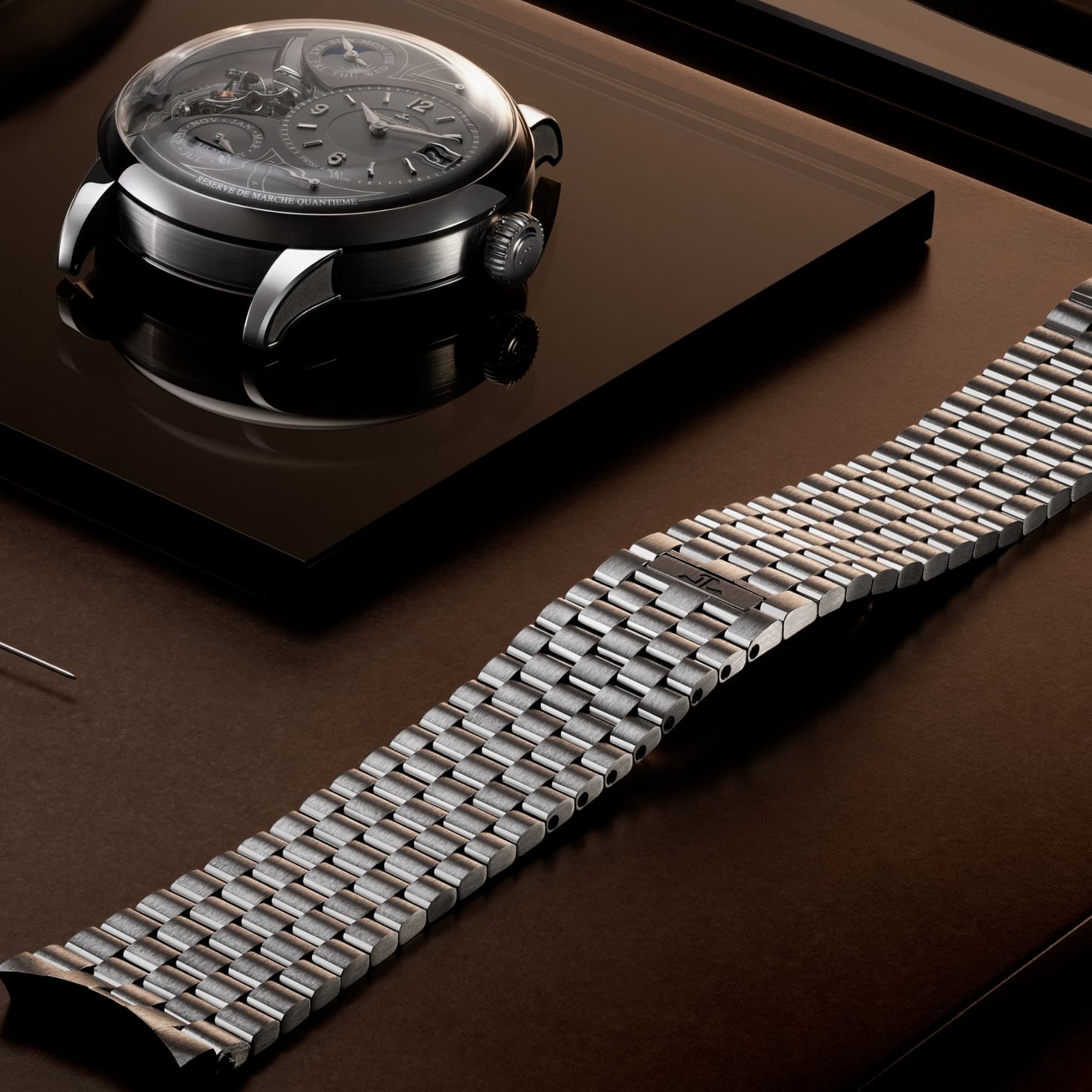
Created specifically for this reference, the five-row platinum 950 bracelet integrates fluidly into the case silhouette. Each link is individually domed along the 12-to-6 axis, echoing the curvature of the lugs, with brushed and beveled finishing on both sides. The clasp is executed in white gold 750. On the wrist, the weight is significant — platinum is approximately 60% denser than gold — but the rounded contours and convex crystal soften the visual footprint against a tailored cuff.
The anthracite grey dial brings together opaline, brushed, and azuré finishes across a symmetrical triangular layout. The grande date anchors the apex at 3 o'clock; the two power reserves flank the central time display; moon phase and day occupy the upper register; months and years sit in the lower sector. A curving microblasted and beveled platinum bridge separates the dial side from the tourbillon aperture. The monochromatic palette — platinum case, anthracite dial, platinum bracelet — gives the watch a quality of old-money restraint that is, paradoxically, more striking than ostentation.
Source: JLC
Calibre 388: The Movement Beneath
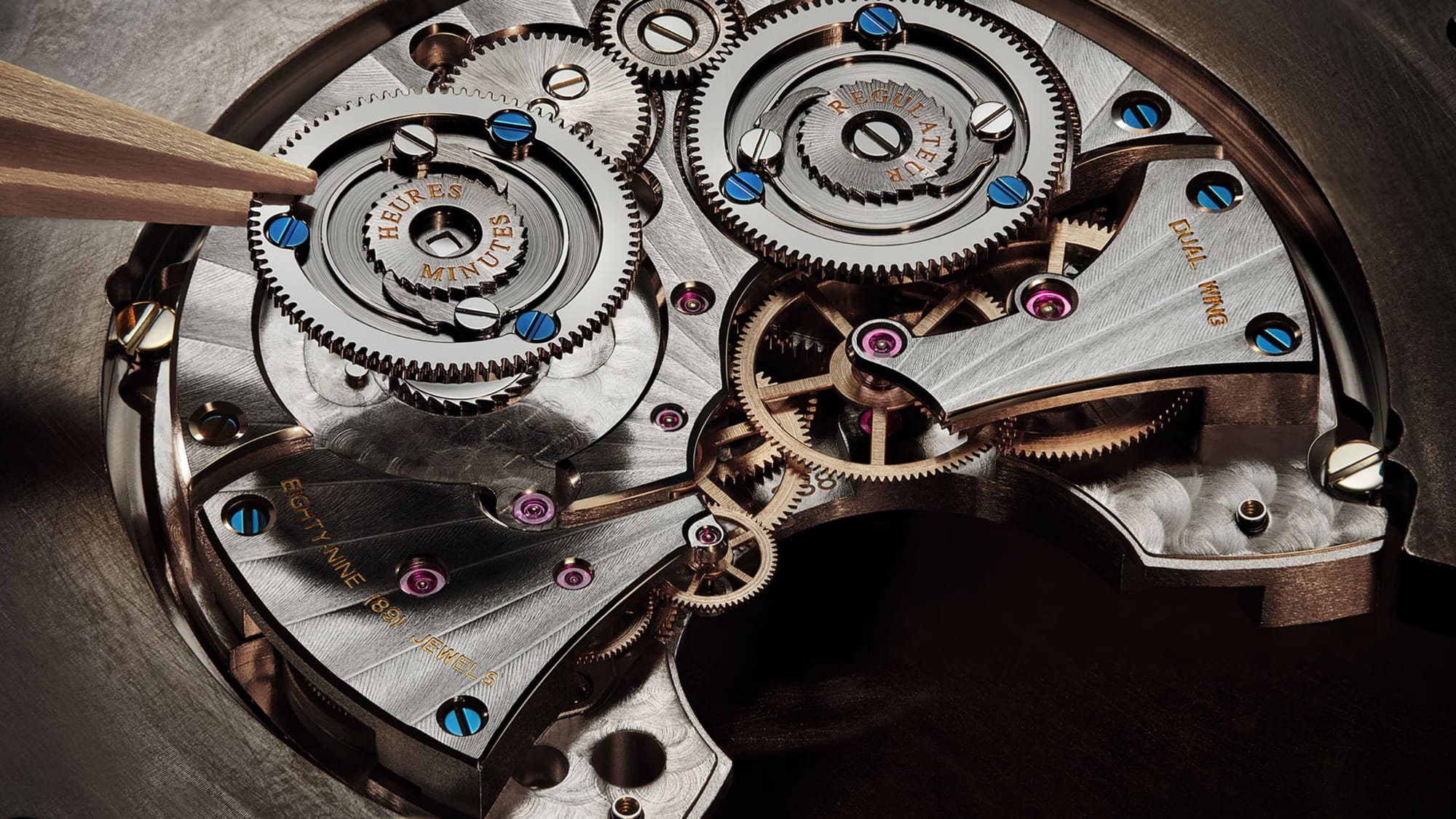
Calibre 388 is a manually wound movement measuring 34.3mm in diameter and 11.15mm in thickness, running at 28,800 vph (4 Hz) with 89 jewels and 655 total components. Every component — including those not visible through the sapphire caseback — is finished to JLC's exacting standards: perlage on the plates, hand-beveled and polished edges on every bridge, and sunrayed Geneva stripes (côtes de Genève soleillées) radiating outward from the center of the movement. The calibre is designed, produced, assembled, and finished entirely in-house at the Le Sentier manufacture in the Vallée de Joux.
The movement's architecture directly informs the dial layout. The triangular arrangement of indications — time on the right, tourbillon on the left, complications above and below — is not a design choice imposed on the movement but an expression of it. The two barrels and their independent gear trains create a natural bilateral symmetry that the dial makes legible.
Access, Exclusivity, and the Nature of Horological Privilege
Twenty pieces. At approximately EUR 500,000 on bracelet (roughly USD 582,000 at current rates) or EUR 420,000 on strap (approximately USD 488,000), the Duometre Heliotourbillon Perpetual in platinum is not a watch for the general collector. It is a watch for the collector who has already acquired most of what the market offers and is looking for something that represents the outer boundary of what is technically possible in a wristwatch.
That exclusivity is not arbitrary. A movement of this complexity — 655 components, a triple-axis tourbillon weighing less than 0.7 grams, a perpetual calendar accurate to 2100, all governed by a patented dual-gear-train architecture — requires an extraordinary concentration of skill to produce. The watchmakers at Le Sentier who assemble Calibre 388 are working at the edge of what human hands can accomplish with mechanical components. Twenty pieces is not a marketing decision. It is a production reality.
JLC's Ascending Arc: A Maison in Its Moment
Viewed in isolation, the Duometre Heliotourbillon Perpetual in platinum is a remarkable achievement. Viewed in the context of Jaeger-LeCoultre's recent trajectory, it is something more: evidence of a manufacture that has found its voice and is speaking with increasing confidence.
The original Heliotourbillon Perpetual at Watches & Wonders 2024 was widely recognized as one of the most technically significant releases of that year. The platinum reinterpretation in 2026 demonstrates that JLC is not content to rest on that achievement — it is refining, recontextualizing, and pushing the same platform further. The Reverso continues to evolve. The Master Control line has been sharpened. And at the apex of the collection, the Duometre platform is being used to explore the outer limits of what a wristwatch can contain.
The watchmaker's watchmaker, as JLC has long been called, is earning that title anew with each successive Watches & Wonders. The platinum Heliotourbillon Perpetual is not just a watch. It is a statement of intent — and a very compelling one at that.
Specifications
Reference: Q6206150
Case: Platinum 950, 44mm diameter, 40 components
Movement: Calibre 388, manual winding, 655 components, 89 jewels
Frequency: 28,800 vph (4 Hz)
Power Reserve: 46 hours per barrel (dual barrel)
Tourbillon: Triple-axis Heliotourbillon, 163 components, less than 0.7g, titanium cages, ceramic ball bearings
Complications: Perpetual calendar, grande date, moon phase (accurate to 122 years), day, month, year, leap year indicator, dual power reserve
Bracelet: Platinum 950, five-row, white gold 750 clasp
Limited Edition: 20 numbered pieces
Price: EUR 500,000 on bracelet / EUR 420,000 on strap (approx. USD 582,000 / USD 488,000)